Aluminum composite panels (ACP), also known as aluminum composite material (ACM), are widely used in building facades, exterior cladding, advertising signs, and architectural decoration. As construction and manufacturing waste continues to accumulate, aluminum composite panel recycling has become an important consideration for waste management companies, metal recyclers, and industrial manufacturers.
However, recycling aluminum composite panels is more challenging than processing ordinary aluminum sheets. Their multilayer structure, combining thin aluminum skins with a bonded core, requires careful consideration when selecting recycling equipment.
An aluminum composite panel shredder is often the first piece of equipment in a mechanical ACP recycling process. Choosing the right shredder can improve material handling, reduce oversized scrap, support downstream processing, and help control operating costs.
So, how do you choose the most suitable ACP shredder for your recycling project?
This guide explains the different types of aluminum composite panels, compares single-shaft and double-shaft shredders, and outlines the most important technical factors to consider before purchasing a machine.
1. What Is an Aluminum Composite Panel?
An aluminum composite panel is a sandwich-structured material consisting of two thin aluminum sheets bonded to a central core.
Depending on its intended application and fire-performance requirements, the core may contain polyethylene (PE), a mineral-filled polymer compound, or a predominantly mineral-based formulation.
Common types of ACP include:
PE-core aluminum composite panels: Frequently used in signage and certain architectural applications. These contain a polyethylene-rich core.
Fire-retardant (FR) aluminum composite panels: Typically contain mineral fillers combined with polymer binders to improve fire performance.
Highly mineral-filled composite panels: Used in applications requiring higher fire-performance classifications, with compositions that can differ significantly from conventional PE-core panels.
The exact composition is important because it affects how the material behaves during cutting, shredding, grinding, and separation.
For example, a polyethylene-rich panel may behave differently under mechanical stress compared with a rigid, highly mineral-filled panel.
Furthermore, ACP waste may contain protective films, coatings, adhesives, screws, brackets, and other contaminants.
Before choosing an ACP recycling machine, it is essential to understand the actual composition and condition of the waste material.
2. Why Is a Specialized Shredder Needed for ACP Recycling?
Unlike conventional metal scrap, aluminum composite panels combine metallic and nonmetallic materials in a bonded structure.
This creates several challenges during mechanical recycling.
Large Panel Dimensions
Aluminum composite panels are commonly supplied in large sheets. Waste from construction sites or fabrication workshops may include full-size panels, irregular offcuts, and folded or bent pieces.
These materials can be difficult to feed directly into a conventional granulator.
An industrial shredder reduces the panels into smaller, more manageable fragments before further processing.
Different Material Properties
Aluminum skins and polymer or mineral-filled cores behave differently when subjected to cutting forces.
A suitable shredder must handle the combined material without excessive jamming, uncontrolled feeding, or unnecessary cutter wear.
Downstream Size Requirements
Shredding is usually only the first stage of ACP recycling.
Depending on the final recycling objective, the shredded material may undergo further size reduction, mechanical liberation, screening, and separation.
Therefore, the shredder should produce material that can be efficiently handled by the next processing stage.
Contamination and Wear
Construction waste may contain unwanted metal fasteners, dust, dirt, or other materials.
These contaminants can increase wear and the risk of equipment damage.
A properly selected shredding system should account for feedstock variability, maintenance accessibility, and overload protection.
3. Single-Shaft vs. Double-Shaft Shredder: Which Is Better for ACP?
One of the most common questions in ACP recycling projects is whether to use a single-shaft shredder or a double-shaft shredder.
Both machines can be suitable for aluminum composite panels, but their operating principles and applications differ.
Single-Shaft Shredder
A single-shaft shredder typically uses a rotating cutting rotor, stationary knives, and a hydraulic feeding mechanism.
Many designs also incorporate a sizing screen to control the discharge particle size.
Advantages:
Better control of output particle size when a suitable screen is installed.
Suitable for relatively consistent manufacturing offcuts and prepared sheet materials.
Can be integrated with conveyors and downstream granulators.
Useful when a controlled discharge size is required.
Considerations:
Output is influenced by the screen aperture, material composition, and feeding conditions.
Large sheets may require suitable hopper and hydraulic pusher configurations.
Smaller screen openings can increase recirculation, energy consumption, and cutter wear.
Some applications may require pre-cutting or primary shredding.
A single-shaft shredder may be appropriate for factories generating relatively clean, consistent ACP production scrap.
A double-shaft shredder uses two counter-rotating shafts fitted with cutting tools.
The shafts grip, shear, and tear materials into smaller pieces.
These machines are commonly used for bulky, irregular, and difficult-to-feed waste.
Advantages:
Suitable for primary shredding of large or irregular ACP scrap.
High-torque, low-speed cutting action.
Can accommodate a variety of sheet shapes and waste configurations.
Useful as the first stage of a multistage recycling process.
Considerations:
Particle size may be less uniform without additional sizing equipment.
Actual output size depends on cutter geometry, material properties, and machine configuration.
Downstream granulation may still be required.
Cutter selection and shaft protection are important when processing contaminated waste.
A double-shaft shredder is often a practical choice for recyclers receiving mixed-size ACP panels from demolition sites, building renovation projects, and scrap collection facilities.
If your main requirement is to reduce large ACP panels into manageable pieces, a double-shaft shredder may be a good starting point.
If your process requires more consistent particle sizing, a single-shaft shredder may be preferable.
For applications requiring both high-volume feeding and smaller output particles, a two-stage shredding and granulation system may offer a more suitable solution.
The final decision should be based on material testing rather than machine type alone.
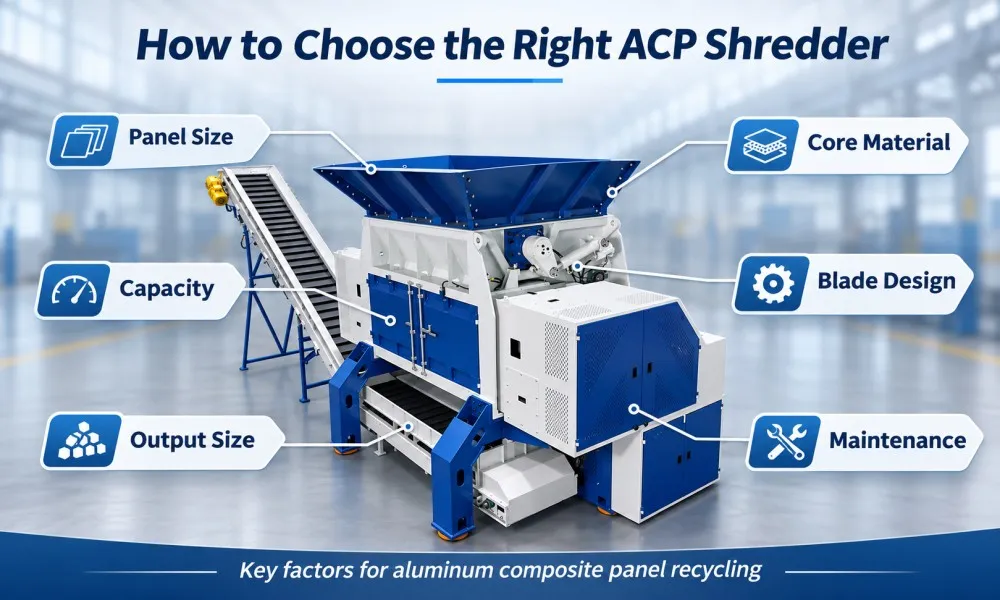
4. Seven Key Factors When Choosing an Aluminum Composite Panel Shredder
Selecting a suitable shredder requires more than simply comparing motor power or machine dimensions.
The following seven factors can significantly influence long-term performance.
4.1 Panel Size and Thickness
Start by determining the maximum size of the ACP waste.
Important dimensions include:
Maximum sheet length and width.
Total panel thickness.
Aluminum skin thickness, when known.
Whether the sheets are flat, folded, rolled, or irregular.
Whether the material contains attached frames or fasteners.
Large-format panels may require an oversized feeding hopper, suitable cutting chamber, or a primary size-reduction stage.
The feed opening should accommodate the actual material geometry, not just its nominal thickness.
4.2 Core Material Composition
Not all aluminum composite panels behave the same way during shredding.
PE-rich materials can soften or smear under excessive heat generated during fine processing, while highly mineral-filled panels may introduce additional abrasive wear and dust.
Therefore, the core formulation should be identified whenever possible.
For mixed ACP scrap, consider separating materials by type before processing.
This can improve feed consistency and simplify downstream recycling.
4.3 Required Processing Capacity
Shredder capacity is generally expressed in kilograms per hour (kg/h) or tonnes per hour (t/h).
However, the rated capacity of a shredder does not necessarily represent its actual throughput when processing ACP.
Throughput depends on several factors, including:
Sheet dimensions and bulk density.
Core composition.
Cutting chamber dimensions.
Rotor speed and cutter arrangement.
Feed consistency.
Target discharge size.
Downstream equipment capacity.
For example, processing compact, uniform ACP offcuts can be very different from processing large, lightweight demolition panels.
A suitable machine should be selected according to the required sustained throughput under realistic operating conditions.
When requesting a quotation, specify the actual amount of waste generated per hour or per working shift.
4.4 Output Particle Size
The desired output size is one of the most important parameters in shredder selection.
Larger fragments may be sufficient when the objective is transportation, storage, or primary size reduction.
Smaller and more consistent fragments may be required when the shredded material will be transferred to a granulator, mill, or mechanical separation system.
However, reducing particle size does not automatically guarantee efficient aluminum-plastic separation.
The relationship between particle size and material liberation must be assessed according to the panel composition and subsequent processing method.
A shredder should therefore be selected as part of the entire recycling process, rather than as an isolated machine.
4.5 Blade Design and Wear Resistance
ACP shredding involves cutting through aluminum skins and bonded core materials.
The design, geometry, and condition of the cutting tools influence:
Cutting efficiency.
Equipment energy demand.
Particle size distribution.
Maintenance requirements.
Cutter service life.
When evaluating a shredder, ask the manufacturer about cutter material, blade replacement procedures, re-sharpening options, and spare parts availability.
For heavily contaminated or mineral-filled ACP waste, wear resistance deserves particular attention.
An appropriate blade configuration should be confirmed through testing whenever practical.
4.6 Motor Power, Torque, and Overload Protection
Industrial shredders need sufficient cutting force to process materials reliably.
However, a larger motor does not automatically mean a better shredder.
Actual performance depends on the relationship between motor power, drive system, shaft speed, available torque, and cutter design.
Low-speed shredders are commonly used for primary size reduction because they can provide controlled cutting action for bulky waste.
When comparing machines, consider features such as automatic reverse operation, overload monitoring, and accessible maintenance points.
These features can help reduce the consequences of material jams and protect critical components.
4.7 Maintenance, Safety, and Operating Costs
The purchase price is only one part of the total ownership cost.
A suitable ACP shredder should also be evaluated based on:
Cutter inspection and replacement accessibility.
Routine maintenance requirements.
Energy consumption under actual working conditions.
Spare parts availability.
Feeding and discharge automation.
Noise and dust-control requirements.
Electrical and mechanical safety provisions.
Dust extraction and suitable material-handling controls may be necessary, particularly where fine polymer dust or mineral-filled material is generated.
The required safety measures should be determined through a project-specific risk assessment.
5. How Does an ACP Shredder Fit into a Complete Recycling Process?
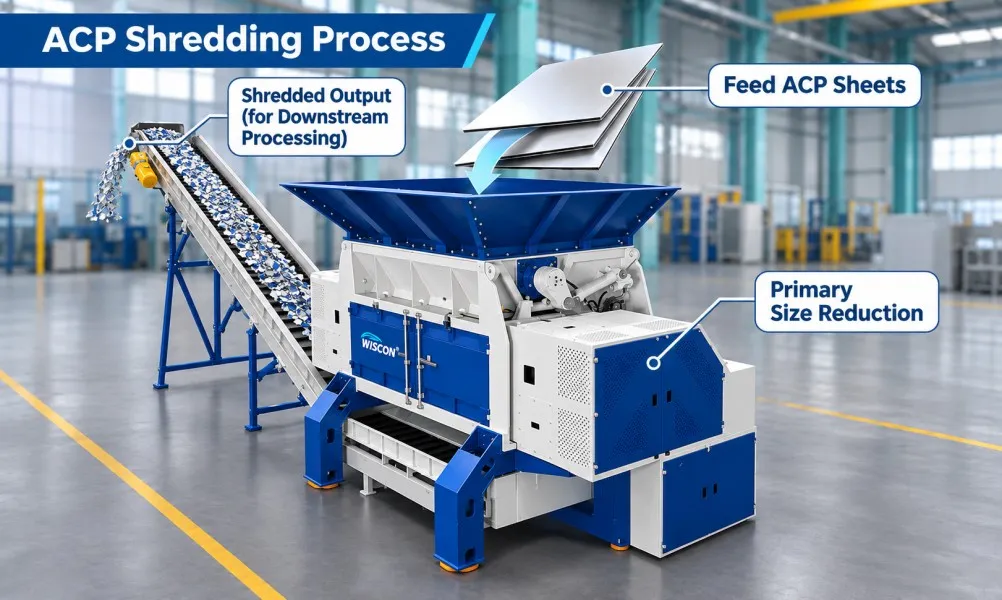
An aluminum composite panel shredder is primarily a size-reduction machine.
It is important to distinguish shredding from the subsequent separation of aluminum and core materials.
A typical mechanical ACP recycling process may include the following stages.
Step 1: Collection and Sorting
ACP scrap is collected from manufacturing facilities, installation activities, renovation projects, and demolition sites.
The material is inspected and, where practical, sorted according to core type, contamination, and panel structure.
Step 2: Primary Shredding
Large panels are fed into an industrial shredder and reduced into smaller fragments.
This helps prepare the material for more controlled downstream processing.
Step 3: Secondary Size Reduction
Depending on the intended separation technology, the shredded material may be processed in a granulator, knife mill, or other suitable size-reduction machine.
The objective is to achieve the particle size and liberation characteristics required by the next stage.
Step 4: Aluminum and Core Material Separation
Mechanical separation systems may use screening, density-based methods, electrostatic separation, or a combination of technologies.
The appropriate method depends on feedstock composition, particle characteristics, and recovery specifications.
Step 5: Recovered Material Processing
Recovered aluminum may be directed to suitable secondary metal recycling operations.
Recovered polyethylene or mineral-containing fractions require appropriate downstream processing or end markets, depending on their composition and purity.
A critical point is that a conventional shredder alone does not produce fully separated aluminum and plastic. Additional liberation and separation equipment may be necessary.
For projects involving metal size reduction and integrated material handling, Wiscon provides Scrap Metal Recycling System solutions.
6. Common Mistakes When Buying an ACP Recycling Shredder
Avoiding the following mistakes can save time and reduce unnecessary investment.
Mistake 1: Choosing Equipment Based Only on Motor Power
Motor power alone does not determine throughput, cutting performance, or particle size.
The cutting chamber, blade configuration, drive system, and material characteristics must also be considered.
Mistake 2: Ignoring the Type of ACP Core
A machine tested only with clean PE-core panels may perform differently when processing heavily mineral-filled or contaminated composite sheets.
Always provide representative material information.
Mistake 3: Choosing an Unrealistically Small Output Size
Smaller particles may require more energy and additional processing stages.
Specify the particle size actually required by the downstream equipment rather than automatically choosing the smallest possible output.
Mistake 4: Overlooking Feeding Efficiency
A machine with sufficient cutting capacity may still experience low overall productivity if the feeding system cannot handle large or flexible sheets effectively.
Evaluate the complete feeding, shredding, and discharge process.
Mistake 5: Buying Without Material Testing
Machine specifications cannot fully predict performance with every type of composite panel.
Representative feedstock trials can help verify throughput, output characteristics, cutter performance, and operational stability.
7. Why Consider Wiscon for Aluminum Composite Panel Shredding?
Choosing an industrial shredding equipment supplier involves more than purchasing an individual machine.
A recycling project should begin with a clear understanding of the waste material, required processing capacity, and downstream recycling objectives.
Wiscon Envirotech specializes in industrial shredders, granulators, and waste size-reduction equipment for a variety of recycling applications.
For ACP-related projects, equipment evaluation can focus on several important areas:
Material-Specific Machine Selection
Different aluminum composite panels may require different cutter arrangements, feeding mechanisms, and size-reduction configurations.
Single-Shaft and Double-Shaft Shredding Options
Machine selection can be evaluated according to panel dimensions, material characteristics, and output requirements.
Integration with Downstream Processing
Shredder discharge characteristics should be considered alongside subsequent granulation, conveying, and separation requirements.
Technical Evaluation Before Purchasing
Providing detailed feedstock information and, where practical, representative material samples can support more accurate equipment selection.
Can an industrial shredder process aluminum composite panels?
Yes. Industrial shredders can be used to reduce aluminum composite panels into smaller fragments, provided the machine is appropriately configured for the material.
The most suitable machine depends on panel dimensions, core composition, contamination, and required output size.
Is a single-shaft or double-shaft shredder better for ACP?
Neither type is universally better.
Double-shaft shredders are often suitable for primary size reduction of large or irregular panels.
Single-shaft shredders may be more suitable when controlled particle size is required.
Material testing is recommended before selecting a machine.
Can an ACP shredder separate aluminum from plastic?
Not completely on its own.
A shredder primarily reduces material size. Additional grinding, liberation, and mechanical separation may be needed to recover aluminum and core materials as separate fractions.
What is the ideal output size for ACP shredding?
There is no universal ideal particle size.
The appropriate size depends on whether the objective is volume reduction, secondary granulation, or preparation for a particular separation process.
The downstream equipment requirements should guide shredder selection.
Can fire-rated aluminum composite panels be shredded?
Many fire-rated ACP materials can be mechanically size-reduced, but their mineral-filled cores may affect cutter wear, dust generation, and subsequent separation.
Equipment suitability should be verified for the specific panel composition.
How much does an aluminum composite panel shredder cost?
The price depends on machine size, cutting chamber dimensions, drive power, cutter arrangement, automation level, and additional equipment.
For a meaningful quotation, provide the material specifications, required capacity, and target output size.
Choose an ACP Shredder Based on Your Recycling Objectives
Choosing the right aluminum composite panel shredder requires a clear understanding of the material and the complete recycling process.
A double-shaft shredder may be suitable for reducing large, bulky ACP waste, while a single-shaft shredder can be a practical option when more controlled output sizing is required.
More importantly, the equipment should be selected based on actual panel composition, processing capacity, feeding requirements, and downstream recovery objectives.
The right shredding configuration can support reliable material handling, efficient size reduction, and smoother integration with subsequent recycling equipment.
Looking for an Aluminum Composite Panel Shredding Solution?
Wiscon Envirotech provides industrial shredding and size-reduction equipment for a wide range of waste processing applications.
If you are planning an ACP recycling project, share the following details with our technical team:
ACP material type and core composition.
Maximum panel dimensions and thickness.
Required processing capacity in kg/h.
Desired output particle size.
Whether the material requires primary shredding only or further processing.
With this information, our team can help evaluate suitable shredding equipment and project requirements.


 4. Seven Key Factors When Choosing an Aluminum Composite Panel Shredder
 7. Why Consider Wiscon for Aluminum Composite Panel Shredding?
 How to Choose the Right Aluminum Composite Panel Shredder?
 Single-Shaft vs. Double-Shaft Bamboo Shredder: Which One Is Better?
 Leather Waste Shredder Jamming? Common Causes and Practical Solutions
 How to Choose a 3,000 kg/h Plastic Shredder for Film and Packaging Waste
 Carpet Recycling: A Complete Guide to Materials, Processes and Recycled Products
