Bamboo waste is not as easy to shred as ordinary wood. Its hollow structure, tough outer surface, and long fibers can create feeding problems, uneven particles, and excessive blade wear if the wrong equipment is used.
For bamboo processing plants, furniture manufacturers, and biomass recycling facilities, choosing the right bamboo shredder directly affects production efficiency and operating costs.
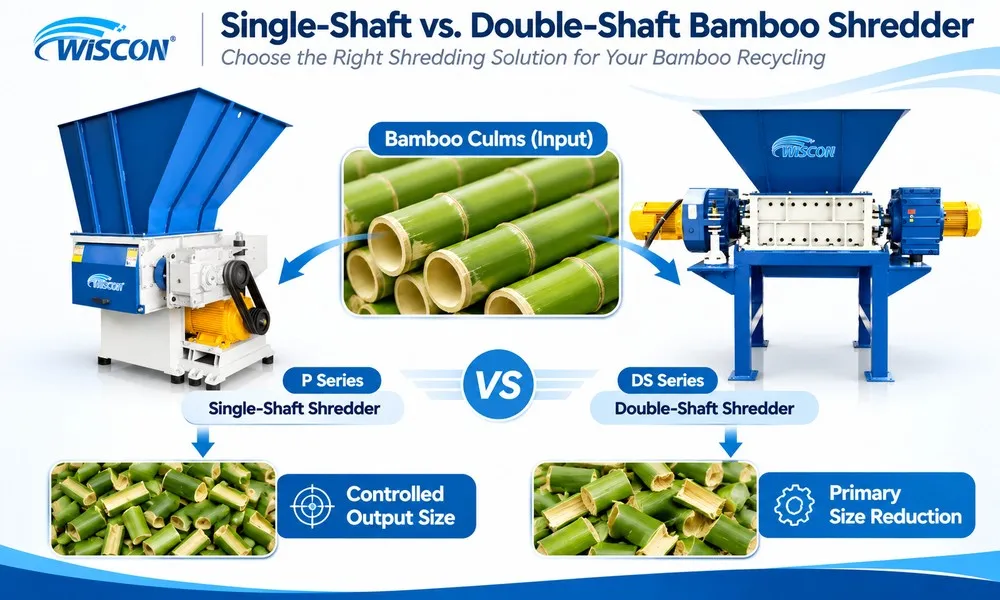
Two common industrial solutions are single-shaft and double-shaft shredders. Both can process bamboo waste, but they serve different purposes.
So, which machine makes more sense for your operation?
How Does a Single-Shaft Bamboo Shredder Work?
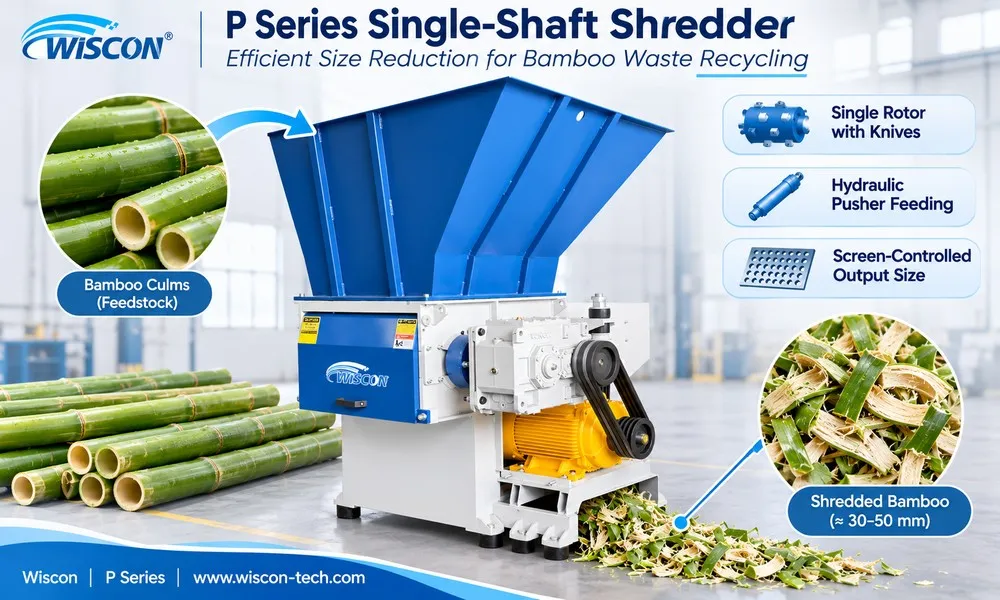
A single-shaft bamboo shredder uses one rotating shaft fitted with cutting knives. A hydraulic pusher moves bamboo waste toward the rotor, where rotating and stationary knives cut the material into smaller pieces.
A screen beneath the cutting chamber controls discharge size. Oversized material remains inside until it becomes small enough to pass through.
This makes single-shaft shredders particularly suitable for processing bamboo offcuts, short bamboo sections, and relatively uniform manufacturing waste.
Published general throughput range: 300–2,000 kg/h
These are standard machine specifications, not guaranteed bamboo-processing results. Actual capacity depends on bamboo diameter, moisture content, feeding conditions, and screen selection.
The main advantage is predictable output sizing, especially when shredded bamboo requires further processing.
How Does a Double-Shaft Bamboo Shredder Work?
A double-shaft bamboo shredder operates differently.
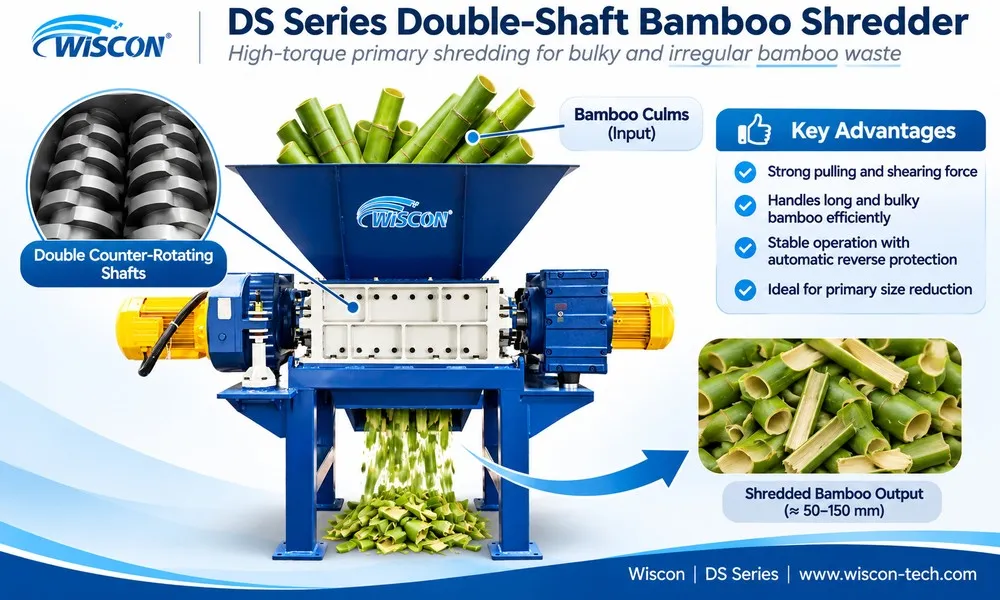
Two counter-rotating shafts equipped with cutting discs grab, compress, and shear bamboo into smaller sections. The material is pulled into the cutting chamber without requiring a conventional hydraulic feeding pusher.
Unlike most single-shaft designs, standard double-shaft shredders do not use a discharge screen. This allows material to exit more freely, although particle sizes are less uniform.
Blade thickness options: 20 or 40 mm, depending on model
Dual-motor configurations
Automatic reverse protection against overload
The low-speed, high-torque cutting mechanism is useful for bulky bamboo culms, irregular bamboo bundles, and high-volume primary size reduction.
However, blade thickness alone does not determine the maximum particle length. Long fibers may still require secondary cutting.
Single-Shaft vs. Double-Shaft Bamboo Shredder: Key Differences
Comparison
Single-Shaft Shredder
Double-Shaft Shredder
Cutting system
One rotor and fixed knives
Two counter-rotating shafts
Feeding method
Hydraulic pusher
Self-feeding cutting shafts
Particle size
More consistent
More variable
Discharge screen
Usually included
Usually not included
Main application
Controlled size reduction
Primary shredding
Typical bamboo feed
Sorted offcuts
Bulky, irregular bamboo
Main consideration
Screen blockage
Oversized, stringy discharge
Neither design is automatically better in every situation. The deciding factor is what happens to the shredded bamboo afterward.
Which Bamboo Shredder Is Better for Different Applications?
1. Bamboo Furniture and Flooring Waste
Bamboo furniture factories often generate relatively clean production waste, including trimmed strips, cutoffs, and rejected components.
A single-shaft bamboo shredder is generally a practical option when consistent particle sizing is important.
Screen-controlled material can be easier to handle before further milling, although very fine processing may require additional equipment.
2. Bamboo Plantation and Landscaping Waste
Harvested bamboo often arrives in long, hollow, irregular sections.
A double-shaft shredder can provide stronger material engagement during primary processing, particularly when the objective is to reduce bulky waste before transportation or secondary shredding.
For exceptionally long bamboo poles, pre-cutting or a specially designed feeding system may still be necessary.
3. Bamboo Biomass Fuel Production
For biomass energy applications, particle size and moisture content are critical.
A double-shaft shredder can perform the first reduction stage, while a single-shaft machine or secondary mill can provide more controlled sizing.
Wiscon’s agricultural waste shredding solutions cover both machine configurations, with the selection depending on required capacity and downstream processing.
What About Energy Consumption and Operating Costs?
Comparing motor power alone can be misleading.
Consider a hypothetical bamboo recycling operation processing 1,000 kg per hour.
If the complete shredding system consumes an average of 45 kW during production:
Specific energy consumption = 45 kWh ÷ 1 tonne = 45 kWh/tonne
At an electricity price of $0.12/kWh, the corresponding electricity cost is approximately $5.40 per tonne.
This is an illustrative calculation, not measured performance data for either machine.
Actual operating costs also include blade replacement, maintenance, labor, downtime, and additional size reduction.
A double-shaft machine may reduce feeding interruptions, but adding a secondary shredder increases total energy demand. A single-shaft system may eliminate that extra stage when its output already meets the required specification.
How to Choose the Right Bamboo Shredder
Before purchasing, evaluate four practical factors:
Feedstock characteristics: Is the bamboo fresh, dry, whole, or already cut into shorter sections?
Required output size: Does the downstream process need controlled particles or simply reduced material volume?
Production capacity: How many tonnes must the system process per hour?
Operating conditions: What are the available power supply, feeding equipment, and maintenance resources?
A material trial using representative bamboo samples is the most reliable way to validate throughput, particle size, and energy consumption.
Final Verdict: Which Bamboo Shredder Should You Choose?
Choose a single-shaft bamboo shredder when particle-size control and relatively uniform bamboo waste are priorities.
Choose a double-shaft bamboo shredder when handling bulky bamboo, irregular feedstock, or primary size reduction.
For facilities requiring both high intake capacity and smaller final particles, a two-stage shredding system may offer a better balance.
At Wiscon, we provide industrial shredding equipment and customized waste recycling solutions. Our technical team can help evaluate your bamboo feedstock, production requirements, and downstream applications.
Explore our equipment at www.wiscon-tech.com or contact us to discuss a suitable bamboo shredding solution.


 How Does a Single-Shaft Bamboo Shredder Work?
 Single-Shaft vs. Double-Shaft Bamboo Shredder: Key Differences
 How to Choose the Right Bamboo Shredder
 How to Choose the Right Aluminum Composite Panel Shredder?
 Single-Shaft vs. Double-Shaft Bamboo Shredder: Which One Is Better?
 Leather Waste Shredder Jamming? Common Causes and Practical Solutions
 How to Choose a 3,000 kg/h Plastic Shredder for Film and Packaging Waste
 Carpet Recycling: A Complete Guide to Materials, Processes and Recycled Products
