As agricultural production continues to expand, large quantities of crop residues are generated every year, including corn stalks, wheat straw, rice straw and other fibrous biomass materials.
For farms, biomass processors and agricultural waste recycling companies, the challenge is no longer simply how to dispose of these materials. The more important question is how to convert crop residues into usable resources with stable processing efficiency and reasonable operating costs.
A crop straw shredder provides an important first step in this process.
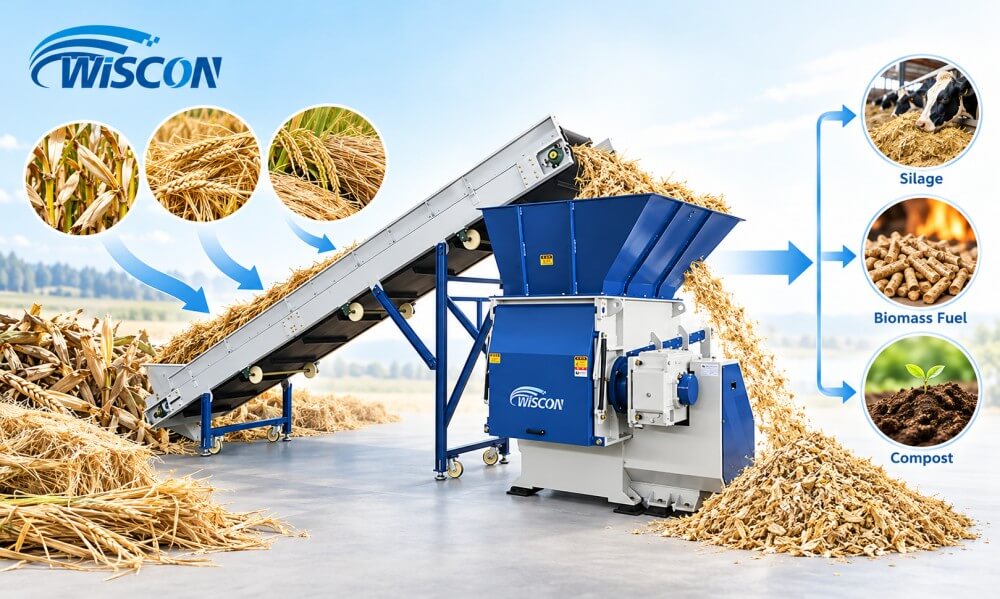
By reducing bulky and irregular agricultural residues into smaller and more uniform material, Wiscon shredding systems help prepare crop straw for silage production, biomass fuel processing, composting and other resource recovery applications.
Why Crop Straw Requires Size Reduction
Untreated agricultural straw is often difficult to handle because of its long fibers, low bulk density and irregular structure.
Corn stalks, wheat straw and rice straw can occupy significant storage space and may create difficulties during conveying, mixing and downstream processing.
Mechanical size reduction helps improve material consistency before the straw enters the next processing stage.
Depending on the application, shredded straw can offer several practical advantages:
easier conveying and material handling;
more consistent particle size;
improved mixing with other feedstock;
better suitability for compression or densification;
more stable feeding into downstream equipment;
reduced storage volume in certain processing systems.
For biomass recycling projects, proper shredding is therefore not only a volume reduction process. It is an important step in preparing agricultural residues for further utilization.
Wiscon Crop Straw Shredder for Different Agricultural Residues
Wiscon crop straw shredders are designed for processing a wide range of fibrous agricultural materials, including:
corn stalks;
wheat straw;
rice straw;
sorghum stalks;
grass and forage residues;
other dry or semi-dry agricultural biomass.
The shredding system applies mechanical cutting, tearing and size reduction to break down long-fiber materials into a more manageable form.
The final particle size can be selected according to the characteristics of the raw material and the requirements of the downstream process.
Rather than using one fixed configuration for every application, Wiscon evaluates factors such as feedstock condition, moisture content, fiber length, required throughput and target output size before recommending a suitable shredding solution.
Crop Straw Shredding for Silage Preparation
Silage is one of the common utilization routes for agricultural residues and forage materials.
Before ensiling, appropriate particle size is important because oversized stalks can be difficult to mix, compact and store efficiently.
A straw shredding machine can reduce long stalks into smaller pieces that are easier to handle during silage preparation.
For suitable feed materials, more uniform particle size can support:
improved material distribution;
easier compaction;
more convenient loading and conveying;
better integration with mixing and storage equipment.
The shredder itself does not determine silage quality. Factors such as crop type, moisture content, fermentation conditions and storage management remain equally important.
However, consistent mechanical preparation can provide a more reliable feedstock condition for the overall silage production process.
Automated Feeding Improves Continuous Processing
Agricultural biomass is challenging to feed continuously because it is lightweight, bulky and often difficult to control.
A complete crop straw shredding system therefore requires more than a shredder alone.
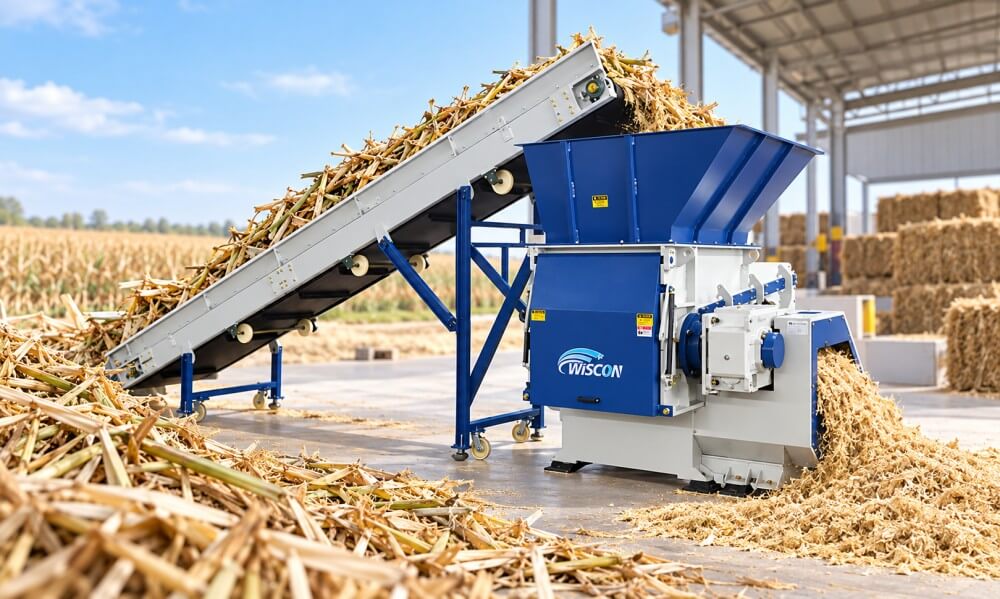
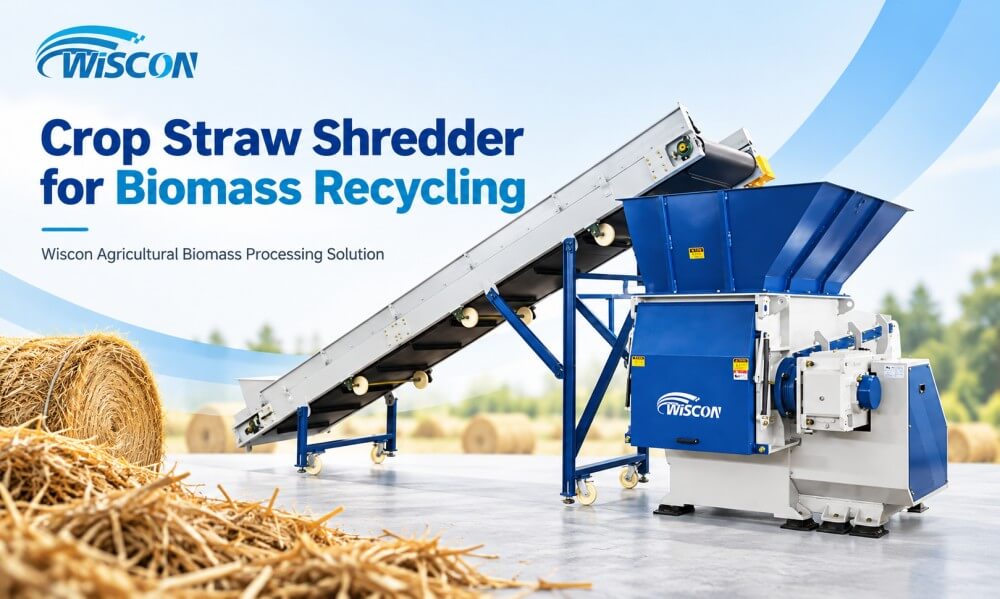
Wiscon can integrate the shredding unit with feeding conveyors, discharge conveyors and other material handling equipment to create a more continuous processing line.
A properly designed feeding system helps maintain stable material flow and reduces unnecessary manual handling.
For large farms, biomass recycling plants and agricultural processing facilities, this can improve overall system efficiency while reducing labor intensity.
From Crop Residue to Reusable Biomass
Shredded agricultural straw can be used in several downstream applications depending on local resources and market demand.
Silage and Animal Feed Preparation
Suitable crop residues may be processed and incorporated into livestock feed or silage systems after appropriate evaluation and preparation.
Shredding helps reduce material size and improve handling before mixing or ensiling.
Biomass Fuel Production
Agricultural residues can also be used as biomass fuel feedstock.
Before pelletizing, briquetting or other densification processes, size reduction is often necessary to create a more uniform input material.
A biomass shredder can therefore serve as a pre-processing machine in biomass fuel production lines.
Composting and Organic Fertilizer
Crop straw can be combined with manure and other organic materials for composting.
Reducing straw size can improve mixing and make the material easier to incorporate into a controlled composting system.
The processed biomass may later be used in soil amendment or organic fertilizer production, depending on the specific process and regulatory requirements.
Other Biomass Recycling Applications
Agricultural fibers may also enter other recycling and resource recovery processes.
The exact processing route depends on the material properties, end-product requirements and local market conditions.
In most cases, consistent size reduction makes the feedstock easier to store, transport and process.
Reducing Open Burning Through Resource Recovery
In some agricultural regions, crop residues are still burned or left unused after harvesting.
Open burning wastes potentially valuable biomass and can contribute to smoke, particulate emissions and local air pollution.
Mechanical processing creates an alternative route.
By shredding agricultural residues and preparing them for reuse, farms and processors can redirect crop waste toward productive applications such as animal feed, composting or renewable biomass fuel.
This approach supports a more circular agricultural system in which residues are treated as secondary raw materials rather than unwanted waste.
Building a More Efficient Agricultural Recycling System
Crop straw recycling is most effective when the entire processing chain is considered.
A typical agricultural biomass recycling system may include:
raw material collection → feeding → shredding → conveying → secondary processing → final utilization
Each stage affects the performance of the overall system.
If the shredder is too small, production capacity may be limited.
If the feeding system is unstable, material bridging or irregular loading may reduce efficiency.
If the output size does not match the downstream process, additional size reduction may be required.
For this reason, Wiscon focuses on complete application requirements rather than selecting equipment based only on motor power or nominal capacity.
How to Select a Crop Straw Shredder
Several factors should be evaluated before choosing a straw shredding machine.
1. Type of Agricultural Residue
Corn stalks, wheat straw and rice straw differ in fiber structure, moisture level and bulk density.
These differences influence shredder selection and feeding design.
2. Moisture Content
Dry straw and freshly harvested biomass behave differently during shredding.
Moisture content can affect feeding stability, cutting performance and final material characteristics.
3. Required Throughput
Processing capacity should be matched to the actual amount of biomass generated or collected.
Both hourly throughput and daily operating time should be considered.
4. Target Output Size
Silage preparation, pellet production and composting may require different particle sizes.
The shredder configuration should therefore be selected based on the downstream application.
5. Feeding Method
Loose straw, baled straw and pre-cut material may require different feeding arrangements.
A suitable conveyor or feeding system helps improve operational stability.
6. Downstream Equipment
The output of the shredder must be compatible with the next processing stage, whether that is a mixer, baler, pellet mill, composting system or another machine.
Why Choose Wiscon for Agricultural Biomass Shredding
Wiscon develops shredding and size reduction equipment for solid waste and biomass recycling applications.
For crop straw projects, the equipment configuration can be selected according to actual processing conditions rather than relying on a single standard solution.
Wiscon can evaluate:
raw material type;
moisture level;
initial material size;
required processing capacity;
target particle size;
feeding method;
downstream process;
available installation space.
This application-based approach helps improve equipment suitability and reduces the risk of selecting a shredder that does not match the real operating conditions.
Frequently Asked Questions About Crop Straw Shredders
What materials can a crop straw shredder process?
A crop straw shredder can process a range of fibrous agricultural residues, including corn stalks, wheat straw, rice straw, sorghum stalks, forage residues and similar biomass materials.
The suitable machine configuration depends on material moisture, fiber structure and required output size.
Can shredded straw be used for silage?
Certain agricultural and forage materials can be used in silage production after suitable preparation.
Shredding helps reduce stalk length and improve handling, mixing and compaction.
Silage quality also depends on crop condition, moisture content, fermentation management and storage conditions.
Can a straw shredder be used before pelletizing?
Yes. Size reduction is commonly required before biomass pelletizing or briquetting.
A shredder can be used as a pre-processing machine to reduce oversized crop residues before further grinding, drying or densification.
What is the ideal particle size for shredded straw?
There is no single ideal size for every application.
The required output size depends on whether the material will be used for silage, composting, biomass fuel or another process.
Wiscon can recommend a suitable shredding configuration based on the downstream requirement.
Can Wiscon provide a complete straw processing line?
Yes. In addition to the shredder, Wiscon can configure feeding, conveying and discharge equipment according to the project requirements.
For larger applications, the system can be designed as an integrated agricultural biomass processing line.
Turn Agricultural Residues Into Valuable Resources
Crop straw does not have to remain a low-value agricultural residue.
With appropriate collection, shredding and downstream processing, materials such as corn stalks, wheat straw and rice straw can become useful feedstock for livestock, biomass energy, composting and other recycling applications.
A reliable crop straw shredder is one of the key machines that connects agricultural waste collection with further resource recovery.
Wiscon provides shredding solutions for different biomass materials and processing capacities, helping agricultural producers and recycling companies build more stable and efficient straw processing systems.
Call to Action
Looking for a suitable shredder for corn stalks, wheat straw, rice straw or other agricultural biomass?
Contact Wiscon with your raw material type, required capacity and desired output size. Our team can recommend a suitable shredding system based on your actual application.


 Reducing Open Burning Through Resource Recovery
 Frequently Asked Questions About Crop Straw Shredders
 Wind and Solar Recycling: Solar Panel Dismantling and Material Recovery Technologies
 Crop Straw Shredder Supports Efficient Agricultural Biomass Recycling
 Why Are Integrated Shredder and Crusher Machines Gaining Attention in Solid Waste Recycling?
 200L Plastic Drum Shredder: How to Prevent Jamming and Improve Recycling Efficiency
 Is Leather Waste Recycling Profitable?