As plastic recycling, industrial waste recovery, and recycled material processing become increasingly automated, recycling companies are paying more attention to how much space, labor, and equipment are required for material size reduction.
A conventional recycling line often uses a separate shredder, conveyor, and crusher. While this configuration remains suitable for many large-scale applications, it also requires additional floor space and material transfer equipment. For recycling plants dealing with bulky materials at moderate throughput, an integrated shredder and crusher machine offers another practical solution.
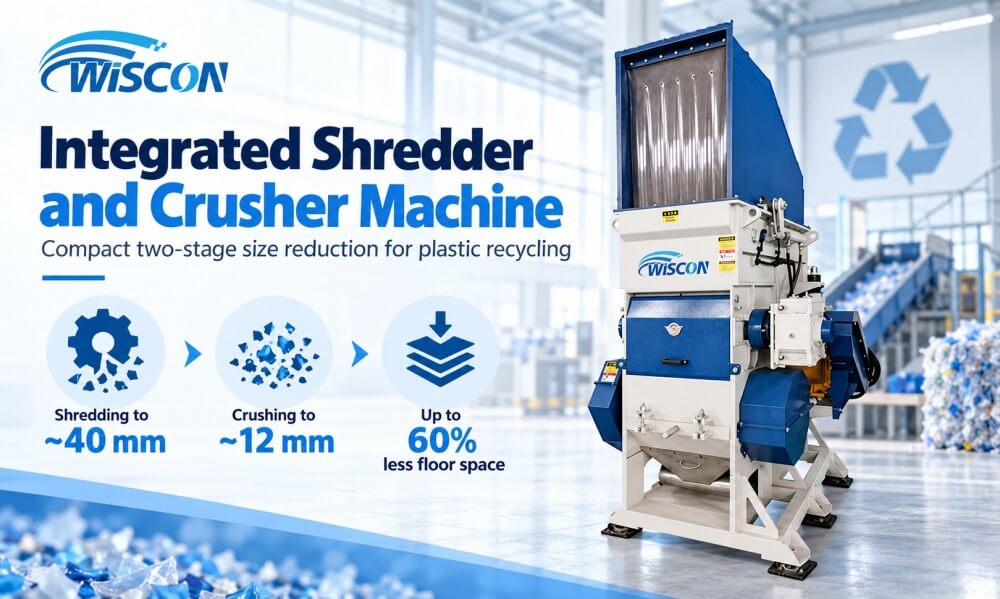
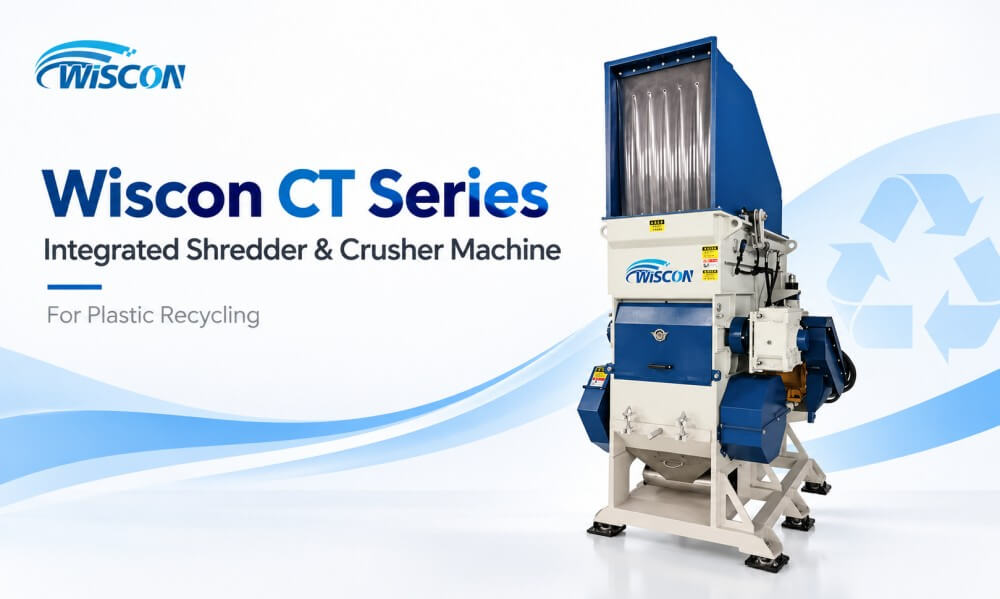
Wiscon’s CT Series combines primary shredding and secondary crushing into one compact machine, allowing bulky plastic waste to be reduced to a smaller, more uniform particle size without an intermediate conveyor.
How Does an Integrated Shredder and Crusher Work?
The CT Series integrates a single-shaft shredder with a granulator-style crusher.
During the first stage, bulky material enters the shredding chamber and is reduced into irregular pieces of approximately 40 mm. Instead of being transferred to another machine by conveyor, the shredded material falls directly into the crushing chamber below.
The second crushing stage further reduces the material to particles of approximately 12 mm, depending on the screen configuration and material characteristics.
This two-stage size-reduction process in a single system simplifies the material flow and reduces the number of separate machines required in the recycling line.
Smaller Footprint for Recycling Plants
Floor space is an important consideration for many recycling facilities, particularly plants handling plastics, injection molding scrap, and factory production waste.
According to Wiscon’s product specifications, the compact vertical arrangement of the CT Series can save approximately 60% of floor space compared with a conventional configuration that uses separate shredding and crushing equipment.
Removing the intermediate conveyor also reduces the number of transfer points between machines. This can simplify line layout and make equipment installation more practical where workshop space is limited.
Two-Stage Size Reduction in One Machine
Another reason integrated shredder-crusher systems are receiving more attention is process efficiency.
Instead of manually transferring coarse shredded material to another crusher, the CT Series allows the material to move directly from the shredding chamber into the crushing chamber.
The machine is controlled by Wiscon’s Smart control system, which coordinates the operation of the upper shredding section and lower crushing section. Automatic overload protection is also designed to reduce the risk of severe overloading and machine blockage.
The shredder and crusher can also be operated independently through system settings when required.
CT400 and CT600 Processing Capacity
Wiscon currently offers the CT Series in different configurations for different processing requirements.
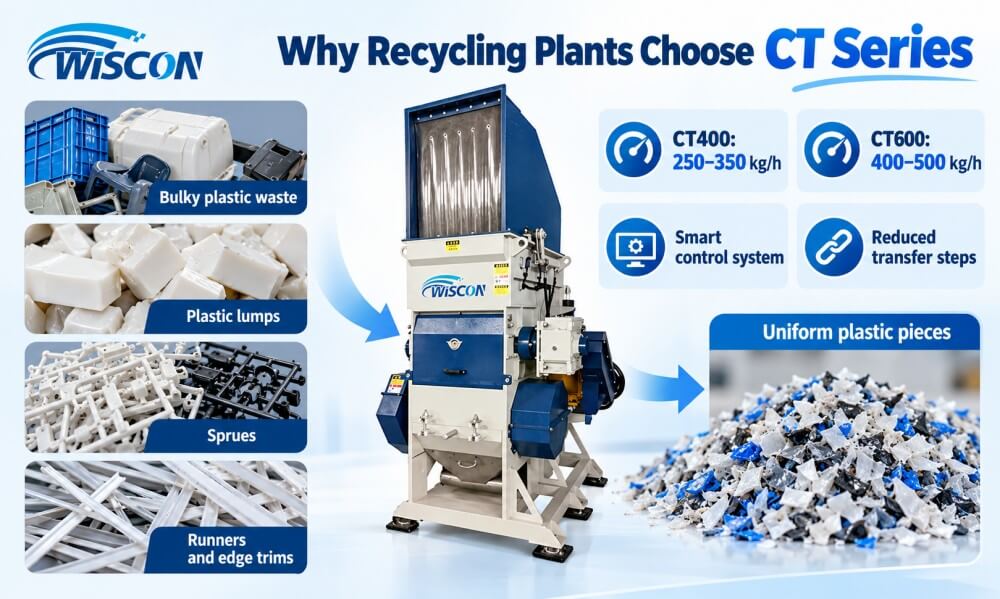
The CT400 has a rated processing capacity of approximately 250–350 kg/h, while the CT600 offers approximately 400–500 kg/h.
Both models use a 230 mm shredder rotor diameter and a standard 12 mm screen opening. The CT400 has a main power configuration of 11 + 11 + 0.75 kW, while the CT600 uses 18.5 + 18.5 + 1.5 kW.
Actual throughput will vary depending on material type, bulk density, feeding conditions, required particle size, and other operating factors. For this reason, equipment selection should be based on the actual waste material rather than rated capacity alone.
What Materials Can the CT Series Process?
Wiscon’s CT Series is mainly designed for bulky plastic materials that require both coarse shredding and further size reduction.
Typical applications include:
Plastic scrap and plastic waste.
Injection molding head lumps and purge material.
Sprues and runners.
Large plastic blocks.
Edge trims and production offcuts.
For processors handling relatively bulky feedstock but requiring moderate production capacity, an integrated shredder and crusher can reduce the complexity of the recycling line while producing smaller particles for subsequent recycling processes.
Why Are Recycling Companies Choosing Integrated Machines?
The growing interest in integrated shredding and crushing equipment reflects a broader change in how recycling plants evaluate machinery.
Purchasing decisions are no longer based solely on maximum throughput. Companies increasingly consider floor-space utilization, energy consumption, automation, labor requirements, maintenance accessibility, and the overall efficiency of the processing line.
By integrating two size-reduction stages into one compact system, the Wiscon CT Series shredder and crusher machine provides a practical option for plastic recycling companies that want to reduce equipment footprint and simplify material handling.
For a recycling project, however, the appropriate configuration should always be determined according to the material, feed dimensions, required output size, hourly capacity, and downstream process.
Frequently Asked Questions
What is an integrated shredder and crusher machine?
An integrated shredder and crusher machine combines primary shredding and secondary crushing in one system. Large materials are first reduced into smaller pieces and then further crushed to achieve a more uniform output size.
What is the capacity of the Wiscon CT Series?
The CT400 has a reference capacity of approximately 250–350 kg/h, while the CT600 can process approximately 400–500 kg/h. Actual capacity depends on the characteristics of the feed material and operating conditions.
What output size can the CT Series produce?
The CT Series typically reduces material to approximately 40 mm during the first shredding stage and then to around 12 mm after secondary crushing with the standard screen configuration.
What materials are suitable for the CT Series?
Typical materials include plastic waste, injection molding scrap, purge lumps, sprues, runners, plastic blocks, edge trims, and other bulky plastic production waste.
What is the main advantage of combining shredding and crushing?
The main advantages are a smaller equipment footprint, fewer material-transfer stages, reduced equipment quantity, and a simpler recycling-line layout.


 What Materials Can the CT Series Process?
 Frequently Asked Questions
 Wind and Solar Recycling: Solar Panel Dismantling and Material Recovery Technologies
 Crop Straw Shredder Supports Efficient Agricultural Biomass Recycling
 Why Are Integrated Shredder and Crusher Machines Gaining Attention in Solid Waste Recycling?
 200L Plastic Drum Shredder: How to Prevent Jamming and Improve Recycling Efficiency
 Is Leather Waste Recycling Profitable?