For cement producers, alternative fuels are no longer only an environmental initiative. Rising coal costs, carbon management, waste recovery, and pressure to improve operating efficiency are pushing more plants to evaluate RDF and SRF as long-term substitutes for fossil fuels.
Among these feedstocks, textile waste RDF is receiving growing attention.
Waste clothing, textile offcuts, fabrics, and selected synthetic fiber waste can be processed through shredding, metal removal, separation, and homogenization to produce a relatively high-calorific-value RDF suitable for cement kilns.
But what actually happens when a cement plant reaches a 10% Thermal Substitution Rate (TSR) using textile waste RDF?
The answer involves more than simply burning 10% less coal. It affects fuel cost, fossil fuel consumption, kiln operation, RDF quality control, and the entire alternative fuel supply chain.
10% TSR Does Not Mean 10% by Weight
This is one of the most common misunderstandings in RDF projects.
Cement plants usually measure alternative fuel use by Thermal Substitution Rate, which represents the percentage of total thermal energy supplied by alternative fuels.
It is not a simple mass replacement ratio.
Consider a cement plant consuming:
100,000 tons of coal per year
Coal lower heating value: 25 GJ/t
The annual fuel input is approximately:
100,000 × 25 = 2,500,000 GJ
At a 10% TSR, RDF must provide about:
250,000 GJ per year
If the textile RDF has a lower heating value of 20 GJ/t, the plant would require approximately:
12,500 tons of RDF per year
This would replace around:
10,000 tons of coal
under these assumptions.
This is why RDF economics should not be judged only by price per ton.
A better metric is:
Cost per GJ of usable thermal energy.
Why Textile Waste Can Be a Good RDF Feedstock
Textile waste contains a high proportion of combustible materials such as cotton, polyester, nylon, and other synthetic fibers.
When properly sorted and processed, it can offer several advantages:
Relatively high calorific value
Low to moderate moisture content
Lower inert material content than many mixed waste streams
Good combustion characteristics
Potential for relatively stable fuel quality
However, textile waste should not automatically be considered premium RDF.
The final fuel quality depends heavily on what is mixed into the waste stream.
PVC coatings, printed materials, artificial leather, zippers, buttons, rubber, footwear components, and other composite materials can significantly affect fuel quality.
For cement kilns, the most important parameters usually include:
Calorific value, moisture, chlorine, ash, metals, particle size, and consistency.
Chlorine Is One of the Key Risks
High calorific value alone does not make a good alternative fuel.
Chlorine is especially important because excessive chlorine input can contribute to internal circulation of volatile compounds in the preheater and calciner system.
This may increase the risk of:
Build-up
Coating formation
Blockages
Process instability
Textile waste is sometimes described as naturally low in chlorine, but this should never be assumed.
PVC printing, coated fabrics, imitation leather, and mixed plastic components can significantly increase chlorine levels.
Therefore:
Low chlorine must be achieved through sorting and verified through testing.
For a cement plant, consistent fuel quality is usually more valuable than a single batch with an excellent calorific value.
A complete RDF system should reduce these fluctuations through shredding, separation, blending, and homogenization.
3. Can the system run continuously?
Cement kilns operate continuously.
If the RDF line stops frequently, even a low-cost fuel becomes difficult to use as a reliable energy source.
For this reason, the endpoint of an RDF production line is not the shredder outlet.
The real endpoint is a fuel that can be consistently delivered to the cement kiln.
Why Higher TSR Requires Better RDF
Once a plant operates successfully at 10% TSR, it may consider increasing the substitution rate to 15%, 20%, or higher.
But increasing TSR is not simply a matter of feeding more RDF.
At higher substitution rates, the kiln becomes more sensitive to variations in:
Calorific value
Moisture
Chlorine
Sulfur
Particle size
Burnout
CO
NOx
Calciner temperature
Preheater build-up
Clinker quality
Feeding accuracy
A fuel fluctuation that is manageable at 5–10% TSR may become significant at 20–30%.
That is why a practical strategy is:
Stabilize the fuel first, then increase the substitution rate.
RDF Is Becoming an Industrial Fuel Product
The RDF market is gradually changing.
In the past, many projects focused mainly on one question:
“Can this waste be burned in a cement kiln?”
Today, cement plants increasingly ask:
“What is the calorific value?”
“What is the chlorine content?”
“How stable is the moisture?”
“What is the particle size?”
“How much does fuel quality vary each day?”
This reflects an important shift.
RDF is moving from being treated as processed waste toward becoming a quality-controlled industrial fuel.
For textile RDF suppliers, future competitiveness will depend less on access to cheap waste and more on the ability to deliver:
Stable calorific value
Controlled chlorine
Controlled moisture
Uniform particle size
Low metal contamination
Reliable supply volume
Cement Plants Need Stable Energy, Not Just RDF
At a 10% thermal substitution rate, textile waste RDF can reduce coal consumption, lower fuel costs, and create a useful outlet for non-recyclable textile waste.
In the example above, 12,500 tons of RDF at 20 GJ/t can replace approximately 10,000 tons of coal and provide around 250,000 GJ of thermal energy.
But the success of the project ultimately depends on fuel consistency.
For a cement plant, the most valuable RDF is not necessarily the cheapest fuel.
It is the fuel that can be measured, conveyed, fed, and burned continuously without disrupting kiln operation.
For Wiscon, this is the core principle behind RDF system design.
A mature textile waste RDF line should not simply produce shredded material.
It should convert variable waste into a more predictable industrial alternative fuel.
If a plant can operate reliably at 10% TSR, then it has a solid basis for evaluating 15%, 20%, or higher substitution rates.
And in most cases, the limit will not be determined only by how much RDF the kiln can burn.
It will be determined by how consistently the RDF can be produced.


 10% TSR Does Not Mean 10% by Weight
 Chlorine Is One of the Key Risks
 The Goal Is Not Just Smaller Particle Size
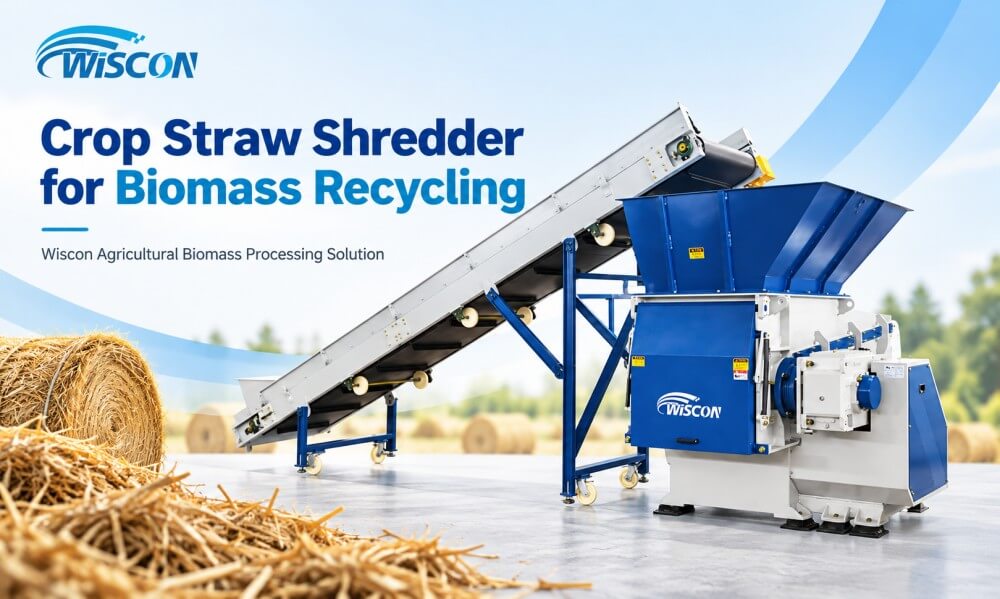 Crop Straw Shredder Supports Efficient Agricultural Biomass Recycling
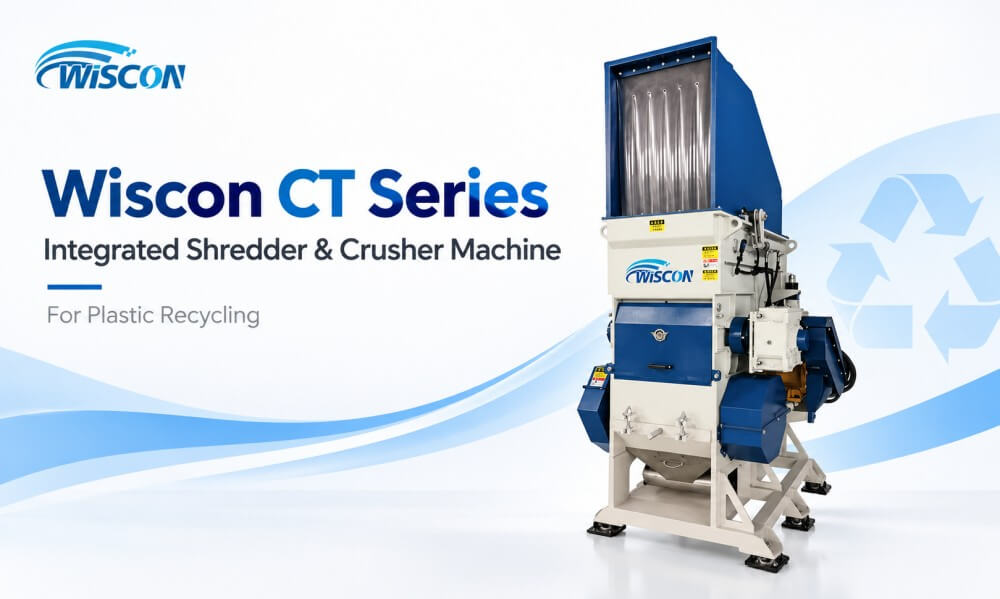 Why Are Integrated Shredder and Crusher Machines Gaining Attention in Solid Waste Recycling?
 200L Plastic Drum Shredder: How to Prevent Jamming and Improve Recycling Efficiency
 Is Leather Waste Recycling Profitable?
 How to Choose the Right Plastic Bucket Shredder for Small-Batch Paint Residue Plastic Recycling?
