Mineral wool is widely used in buildings because it is fire-resistant, sound-absorbing, and effective as thermal insulation. But once it becomes production offcuts, renovation waste, or demolition material, it creates a very practical problem: it takes up a lot of space, is difficult to handle manually, and often goes directly to landfill if no proper recycling process is available.
For contractors, insulation manufacturers, and recycling companies, landfill disposal is no longer just an environmental issue. It is a cost issue. A professional mineral wool shredder can help reduce these costs by cutting waste volume, improving material handling, and preparing mineral wool for reuse or further processing.
Why Mineral Wool Waste Is Expensive to Landfill
The cost of landfill is usually calculated by weight, but mineral wool creates problems by both weight and volume. Loose insulation waste has a low bulk density, which means a truck may reach its volume limit before it reaches its legal weight limit. In real waste handling operations, this often leads to more truck movements, more containers, more labor, and higher transportation costs.
In the United States, construction and demolition debris reached about 600 million tons in 2018. In the European Union, construction and demolition waste accounts for more than one third of total waste generation. Insulation waste is only one part of this stream, but it is one of the materials that many recycling plants still find difficult to manage efficiently.
Landfill tipping fees also continue to put pressure on waste operators. In 2024, the average U.S. municipal solid waste landfill tipping fee was reported at around $62 per ton. In some regions, construction and demolition waste can be higher, especially where landfill capacity is limited or environmental rules are stricter. When transport, container rental, and sorting labor are added, the real cost per ton can be much higher than the gate fee.
How a Mineral Wool Shredder Reduces Waste Volume
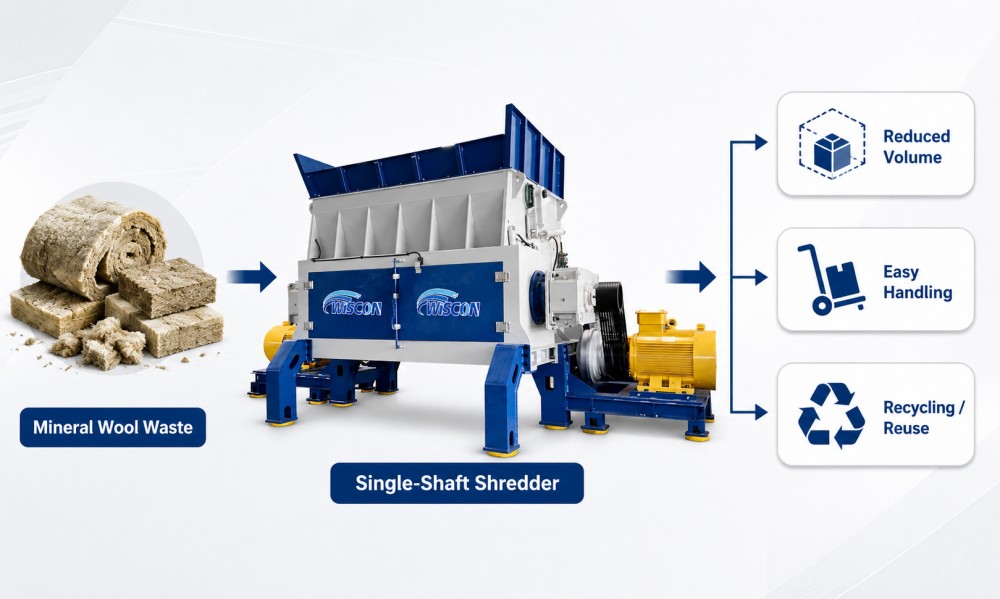
A mineral wool shredder breaks bulky insulation boards, batts, rolls, and offcuts into smaller and more uniform pieces. This improves packing density and makes the waste easier to move, store, and feed into downstream equipment.
For example, a demolition project may generate large bags of mixed mineral wool insulation. Without shredding, these bags occupy valuable container space and are difficult to compact evenly. After shredding, the material can be transported in a more controlled form. Even when the final destination is still landfill, better volume reduction can reduce the number of haulage trips.
In many projects, transport and container costs are more painful than the landfill fee itself. If shredding reduces container exchanges from ten loads to seven loads, the saving is immediate. The exact result depends on moisture, contamination, material type, and machine configuration, but the principle is simple: better size reduction means better logistics.
Preparing Mineral Wool for Recycling Instead of Disposal
The bigger saving comes when a mineral wool shredder helps move the material away from landfill completely. Shredded mineral wool can be easier to separate, meter, and reuse in selected applications. Some manufacturers and recyclers use processed mineral wool waste as a secondary raw material, filler, or input for specialized recycling routes.
Clean production offcuts are usually the best starting point. They are more consistent, less contaminated, and easier to return into controlled processing. Demolition waste is more difficult because it may contain screws, wood, plaster, plastic film, mortar, or dust. In this case, shredding is only one step in the line. Magnetic separation, screening, dust collection, and manual or optical sorting may also be required.
A well-designed mineral wool shredder does not work alone. It should be part of a complete material handling system. The goal is not only to make the waste smaller, but to make it useful, predictable, and easier to sell or reuse.
Lower Labor and Handling Costs
Mineral wool waste is unpleasant to handle. It is light, fibrous, and often dusty. Workers may need protective clothing, masks, and careful operating procedures. When the waste remains in large, loose pieces, handling becomes slower and less efficient.
A mineral wool shredder can reduce manual handling by allowing operators to feed material with conveyors, loaders, or controlled bins. Once the material is shredded, it flows more consistently through the recycling line. This can reduce time spent cutting, bagging, moving, and reloading insulation waste.
For larger recycling facilities, labor efficiency is one of the strongest arguments for investing in shredding equipment. A machine that saves several hours of manual work each day can become more valuable than the landfill savings alone.
Reducing Contamination Penalties and Rejection Risk
Landfills and recycling outlets may reject loads that are poorly sorted, contaminated, or difficult to inspect. Mixed insulation waste can hide metal, plastic, rubble, or wet material. A shredder helps open up the material stream, making it easier to detect and remove unwanted items before final disposal or reuse.
This is especially important for companies that need stable output quality. If shredded mineral wool is going to be reused, particle size and contamination control matter. A reliable mineral wool shredder with the right cutter design, low-speed torque, and dust management can help create a more consistent material stream.
What to Look for in a Mineral Wool Shredder
Not every industrial shredder is suitable for mineral wool. The material is abrasive, fibrous, and dusty. A good mineral wool shredder should have strong torque, wear-resistant cutters, easy maintenance access, dust-control options, and adjustable output size. Low-speed shredding is often preferred because it reduces dust generation and energy waste.
For production offcuts, a single-shaft shredder may be enough when controlled output size is required. For bulky or mixed insulation waste, a double-shaft shredder may offer better feeding performance and resistance to difficult materials. The best choice depends on input size, contamination level, hourly capacity, and the final use of the shredded material.
A Practical Cost Example
Assume a recycling company handles 100 tons of mineral wool waste per month. If the landfill tipping fee is $62 per ton, direct disposal costs are about $6,200 per month before transport and labor. If shredding and sorting help divert 40% of that material from landfill, the company could avoid around $2,480 in monthly tipping fees. Over one year, that equals nearly $30,000, not including savings from fewer containers, fewer truck trips, and reduced manual handling.
This is only a simple example, but it shows why mineral wool shredding deserves attention. The machine is not just a waste-size reducer. It is a cost-control tool.
Conclusion
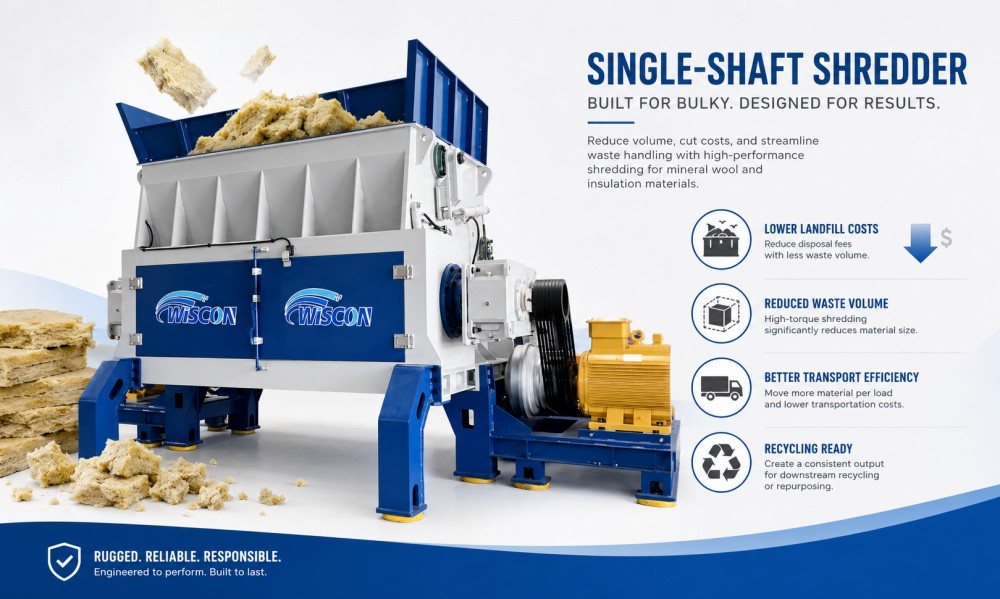
A mineral wool shredder helps reduce landfill costs in three main ways: it cuts waste volume, improves handling efficiency, and prepares mineral wool for recycling or reuse. As landfill fees rise and construction waste regulations become stricter, insulation manufacturers, demolition contractors, and recycling plants need better solutions for bulky mineral wool waste.
The most successful projects start with a clear waste profile: clean offcuts, renovation waste, or mixed demolition material. From there, the right shredder can be selected according to capacity, contamination level, output size, and downstream recycling goals.
For companies dealing with mineral wool waste every week, investing in a mineral wool shredder is not only an environmental decision. It is a practical way to reduce disposal costs, improve site efficiency, and build a more sustainable waste management process.
FAQ
Can mineral wool be recycled after shredding?
Yes, clean mineral wool can often be prepared for selected recycling or reuse routes after shredding. The final application depends on contamination level, particle size, moisture, and local recycling options.
Does a mineral wool shredder reduce landfill tipping fees directly?
A shredder does not change the landfill fee per ton, but it can reduce total disposal cost by improving volume efficiency, reducing transport needs, and helping divert part of the waste from landfill.
What type of shredder is best for mineral wool?
For clean production waste, a single-shaft shredder may work well. For bulky or mixed waste, a double-shaft mineral wool shredder is often preferred because it offers strong feeding performance and high torque.
Need a mineral wool shredder for your recycling project? Contact Wiscon for a customized solution.


 Reducing Contamination Penalties and Rejection Risk
 FAQ
 Crop Straw Shredder Supports Efficient Agricultural Biomass Recycling
 Why Are Integrated Shredder and Crusher Machines Gaining Attention in Solid Waste Recycling?
 200L Plastic Drum Shredder: How to Prevent Jamming and Improve Recycling Efficiency
 Is Leather Waste Recycling Profitable?
 How to Choose the Right Plastic Bucket Shredder for Small-Batch Paint Residue Plastic Recycling?
